
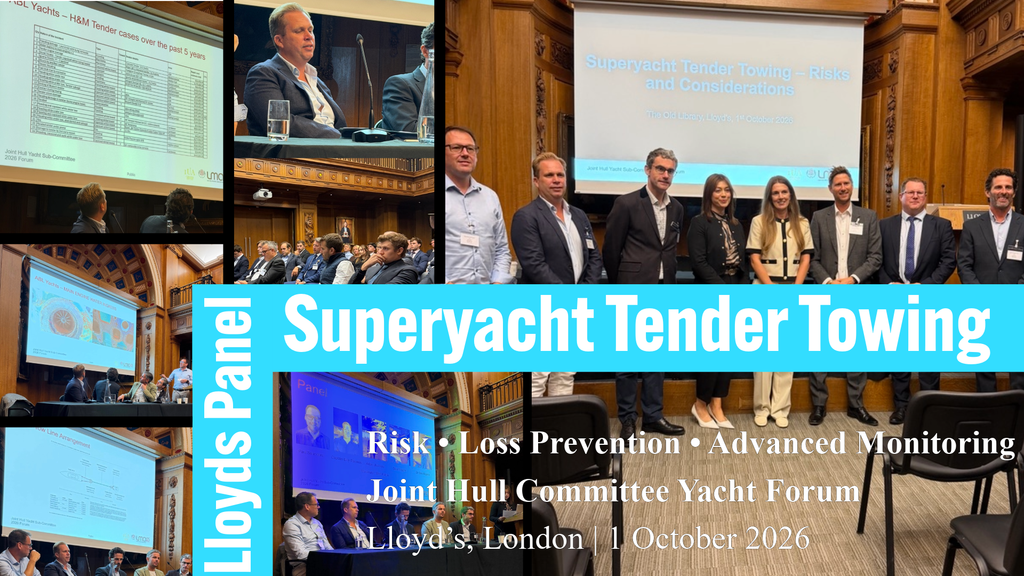
The technology now exists – so why so many tender losses? One of the questions raised at the Joint Hull Committee Yacht Subcommittee’s annual Yacht Forum at Lloyd’s, London, where the focus was superyacht tender towing, risk and loss prevention.
Claims figures certainly gave context to the discussion.
ABL Yachts’ reported just a small snapshot of one company’s data (in 5 years):
47 tender claims
Around US$13.5m in losses
An average claim of approximately US$287,000
Towing-related claims are the dominant loss driver
Flooding, capsizing while under tow and fire account for the largest losses. (AIS doesn’t help)
The majority could potentially have been prevented…..
The discussion explored the whole risk picture: crew training, towing equipment, SOPs, maintenance, tender design, weather, insurance, monitoring systems and early intervention.
Lack of uptake to technology comes down to inertia and confusion over what “monitoring” actually means. Historically, tender technology has often been associated with anti-theft tracking. But knowing where a tender is isn’t the same as knowing what is happening to it.
Advanced tow-protection systems can provide information about developing conditions onboard, giving crew an opportunity to respond before an incident becomes a major loss.
Insurance may also have an important part to play. Some insurers specify the functionality required from advanced monitoring, while others go further and name accepted systems, making the requirement much clearer for clients.
Many insurers will offer lower deductibles and extend their allowances for towing such as at night, away from shore and over 50nm.
A huge thank you to Emily Grew for organising the forum and Matt Halpin for moderating the discussion, the yacht and hull insurance community and to the panel:
Dr. Dan Rogers Dan Rogers — Founder & CTO, Yacht Trace
Paul Saunders — Head of Yachts & Principal Surveyor, ABL Yachts
Dale Rogers — COO, Tow Pro
Adam Jackson — Managing Director & Principal Surveyor, Assure Maritime
Captain Billy Stevens — Superyacht Captain, MCA Master 3,000 GT
👉 I’ve put together the attached article with the claims data and some of the key points raised during the forum.
➡️ Welcome to share and repost ⏩ – it is a very comprehensive guide to what was discussed and the knowledge given by the expert panel.
▶️ A topic where there needs to be greater awareness across the whole industry.
💡 Interestingly beyond towing. A number of Yacht Trace clients just want to know the health and status of their tenders and Jet Skis in order to prevent loss even when not towing.
#Superyachts#TenderTowing#YachtInsurance#SuperyachtTenders#ChaseBoats#YachtTrace#RiskManagement#MarineInsurance#LossPrevention#YachtManagement#SuperyachtCaptain#MarineTechnology#TenderMonitoring
Charles Knight, Pushkar Gadam, Daniel Shacklock, Jason Clarke, Howard LoweSarah Allan, Mike Wimbridge, Michelle Van der Merwe, Marcel Herrera BSc (Hons) Dip CIIMichelle Suckling
Article
Superyacht Tender Towing: Risks, Loss Prevention and the Future of Monitoring Joint Hull Committee Yacht Forum Lloyds London

Deborah Fry
Director of Yacht Trace, Tender Monitoring and Tracking Insurance Approved for Superyachts. Prevention of loss. Self install. Plug and play. Advanced tow protection. Bespoke applications. Jet ski, fleet, lithium.
October 7, 2026
Superyacht Tender Towing: Risks, Loss Prevention and the Future of Monitoring
Joint Hull Committee Yacht Forum brings industry specialists together at Lloyd’s Lloyd’s Market Association
Thursday 1 October 2026 | The Old Library, Lloyd’s, London
On Thursday 1 October 2026, the Joint Hull Committee’s Yacht Subcommittee hosted its annual Yacht Forum in the Old Library at Lloyd’s, London. The 90-minute forum brought together specialists from across the superyacht sector for an in-depth panel discussion on superyacht tenders, with a particular focus on tender towing.
The audience was drawn from yacht and hull insurance practitioners. The panel brought expertise from superyacht operations, casualty investigation, marine surveying, risk management, towing systems and advanced monitoring technology.
Key takeaways
· Towing is a costly part of tender risk. Towing-related incidents were about one third of incidents but around half of repair cost.
· Most casualties were avoidable. The majority could potentially have been prevented.
· Early intervention is decisive. A camera or AIS tracker shows where a tender is, not what is happening inside it.
· People come first. Crew training, competence and experience was the single change the panel most wanted.
· Towing is a complete risk system. No single measure is enough: monitoring, training, equipment, procedures and maintenance all matter.
· Underwriters should look at how the whole towing operation is managed, not only the value of the tender.
Event details
Event
Joint Hull Committee Yacht Subcommittee – Annual Yacht Forum Charles Knight Jason Clarke Daniel Shacklock Pushkar Gadam Emily Grew Matt Halpin
Date and time
Thursday 1 October 2026, 15:00–16:30
Venue
The Old Library, Lloyd’s, London EC3M 7HA
Chair
Moderator
Audience
Yacht and hull practitioners. Underwriters, insureres, brokers, lawyers and other industry professionals
Subject
Superyacht tenders, with a particular focus on tender towing, risk and loss prevention
Background and purpose
Tenders are becoming larger, more valuable and more operationally important. In some cases they are effectively standalone vessels. Insurers see claims from many causes, including towing operations, navigation incidents, flooding, equipment failures, collisions and grounding.
The purpose of the session was not simply to discuss insurance coverage. The panel examined the practical realities of tender towing: what is going wrong, why incidents occur, why some become extremely expensive losses and, crucially, what can be done to prevent them.
The discussion went well beyond whether it is safe to tow a tender. It covered the complete tender-towing risk, from preparing the vessel before departure, to monitoring it throughout a passage, to recovering it safely afterwards.
The expert panel
Dr. Dan Rogers
Founder and Chief Technology Officer, Yacht Trace
An engineer and technology specialist with more than 25 years’ experience developing advanced monitoring and control systems. His contribution focused on how advanced monitoring gives crews information that cannot be obtained by looking at a tender from the mothership, and how new technology is on moving from basic asset tracking towards pre-emptive monitoring and early intervention.
A central point: technology does not replace the captain or crew. Technology is an aid to decision-making. The objective is to identify a developing problem early enough for the crew to do something about it and in particular appropriate technologies for obtaining this information:
· Identification and monitoring of key risk factors
· Independent communication links for high risk factor monitoring
· Simple tracking is not a risk mitigation measure
· New systems being incorperated into to tenders that present new challenges
Paul Saunders
Head of Yachts and Principal Surveyor, ABL Yachts
A former chief engineer, Chartered Marine Engineer and Fellow of the Institute of Marine Engineering, Science and Technology, with ABL since 2013. He brought the casualty-investigation and claims perspective, drawing on ABL’s own tender casualty experience over five years. One of his strongest conclusions was that, looking back at many of the casualties he had investigated, the majority could potentially have been prevented. The presentation of various claims ranged from:
· Minor collision damage
· Damaging water ingress to engines
· Partial submerged while under tow
· Total loss
Captain Billy Stevens
Superyacht Captain, MCA Master 3,000 GT
More than 15 years’ experience operating superyachts worldwide, including over eight years with the same family aboard his current yacht. He brought the practical onboard perspective, covering:
· Passage planning
· Weather and sea-state assessment
· Tow equipment
· Crew competence
· Monitoring during passage
· Towline loads
· Tender recovery
· Crew transfer
· Owner expectations
· Charter pressures
· Deciding when conditions are no longer suitable for towing
Billy emphasised that towing decisions are rarely based on one factor. The captain must consider the safety of people, the vessels and the marine environment while balancing the yacht’s operational requirements.
Adam Jackson
Managing Director and Principal Surveyor, Assure Maritime
More than 30 years in the marine industry, across sea, yacht construction, regulation, surveying and risk management. He previously led the MCA’s large-yacht services team and now advises owners, operators and insurers. His contribution highlighted:
· Standard Operating Procedures
· Formal risk assessments
· Crew familiarisation
· Safety-management systems
· Tow-point standards
· Regulatory requirements
· Permanently towed chase boats
· Whether some large chase boats should effectively be considered standalone vessels
A significant point was the potential gap between how sophisticated modern tender operations have become and the formal procedures governing them.
Dale Rogers
Chief Operating Officer, Tow Pro
Practical boating and towing experience, with a background in technology and business development. He has worked with owners, captains and crews on monitoring solutions to improve towing safety. His contribution examined:
· Different tender designs and their towing characteristics
· Battery and bilge-pump monitoring
· Tow monitoring
· Vessel-health data
· The growing availability of onboard sensor information
· How monitoring data could increasingly be used to understand different vessel and towing risk profiles
Different tender designs can behave very differently under tow and therefore need different approaches to risk management.
Topics covered
Losses: why tender claims are becoming increasingly significant; why towing-related losses can be disproportionately expensive; flooding and progressive water ingress; towline failure and shock loading.
Equipment and design: bilge-pump activity and battery condition; tow points and whether they are designed for sustained offshore towing; tender design and its effect on towing risk; maintenance of tenders compared with motherships; navigation lights and regulatory compliance.
People and procedures: weather forecasting and changing sea conditions; crew training and competence; whether current tender qualifications are sufficient for increasingly large and powerful craft; Standard Operating Procedures and risk assessments; crew transfer between a towed tender and the mothership; owner and charter pressures on captains.
Monitoring: tracking versus active monitoring; pre-emptive monitoring and early intervention.
Insurance and vessel status: the potential role of insurers in encouraging better risk management; whether permanently towed chase boats should increasingly be treated as vessels in their own right.
The claims evidence: ‘some of’ ABL’s five-year data
Claims investigated
47 tender claims over five years, just under 10 a year (one more was instructed the day before the forum)
Total losses
Around US$13.5 million
Average claim
Approximately US$287,000
Largest losses
Approximately US$1.4 million (repaired); a US$1 million fire caused by a drive failure (repaired)
Towing-related incidents
Approximately one third of incidents but around half of the repair cost (about US$6.5 million of US$13.5 million)
Average towing claim
Approximately US$400,000, against approximately US$228,000 for other claims: about 70% higher
By number: flooding was the most common category (9), followed by capsize while towed (8) and machinery failure (8, now 9). Machinery is usually the top category in ABL’s yacht statistics but not for tenders. Other categories included collisions, fires, lifting incidents, capsizes not under tow and heavy weather.
By cost: fire was the most expensive category. There were only three fires, but they made up 22.9% of repair cost. Capsize and flooding categories, including while towed, each accounted for roughly a fifth. Machinery cases were numerous but low in value, because tender engines are small and relatively cheap to repair.
By region: Caribbean and USA 17, Mediterranean 12, Middle East 3. At least three flooding or capsize cases are known to be constructive total losses; ABL does not always learn the final outcome. There was no common tender builder and no single common cause.
Example casualties
· Flooding in calm weather. A tender under tow flooded when its side gate opened. The latch did not line up, so the gate could not be secured. ABL has seen this on several cases.
· Towline failure. In bad weather the tow line parted and a RIB drifted onto rocks, with the bottom ripped out: a constructive total loss.
· Tow rope in the propeller. When a mothership slowed, the tow rope wrapped around its propeller and pulled the tender into the stern. The tender capsized on the next tow.
· No kill cord. Two crew were ejected from a fast tender in significant waves. The kill cords were not connected, so the unmanned tender kept running.
· Seawater in the engine. Faults in a water-cooled exhaust can send seawater through the turbocharger into the cylinders. Unless caught early, this normally means a scrapped engine.
Lessons from the claims
· Early intervention is what separates an incident from a major claim. Crew who catch flooding quickly can stop the water, pump out or use airbags. After seawater enters an engine, fresh-water washing and preserving the engine and electronics limit the damage.
· Consequences can exceed the original damage. A replacement engine may not be compatible with the drive, controls or alarm systems, so a machinery claim can become much larger.
· Training was Paul’s answer to the one-change question: crew training, competence and experience. Some people operating tenders did not know what a kill cord was.
· Learning is not systematic. Some managers issue lessons-learned bulletins across their fleets and experienced captains pass knowledge to junior crew, but this is neither mandatory nor industry-wide.
· Some losses are not preventable. Unexpected heavy weather was the exception; for the majority of casualties, the answer to “could this have been prevented?” was yes.
Towing in practice: the captain’s view
Captain Billy Stevens described a captain’s priorities as protecting human life, the vessel and the marine environment, while meeting owner and crew needs.
The tow system
Working from the yacht to the tender, the system he described has these parts:
· Yacht bridles: nearly the longest section, made of thick, heavy rope. This is the main shock absorber.
· Yacht towing pennant: the main straight section, joined to the bridles by two soft shackles. These Dyneema loops cannot damage the yacht and are quick to undo.
· Tender bridles, connected to the tow line by a quick-release hook so the tow can be released fast if needed.
· Tender bow plates, where the bridle attaches to the tender.
Every component has a safe working load and breaking load except the plates at the tender end, where a safe working load is very hard to establish. He is working with a company to load-test them this winter and argued that the industry needs actual numbers rather than supplier recommendations.
Towing or driving the tender
The decision rests with the master. The factors are:
· Distance and duration. Setting up a tow takes about 25 minutes, so a 25-mile hop is better driven. Over several days, towing rests the crew and saves a large amount of fuel.
· Weather and sea state across the whole passage plan, not just current conditions.
· The tender itself, including its fuel state.
· Navigation: narrow channels, high-traffic areas, islands, atolls and reefs.
· Crew availability, and whether it is safe to put crew in the tender for the trip.
Where things go wrong
He put the towing arrangement first, particularly the tender-end fixings, followed by changing weather. A forecast may under-call the wind and waves. In a following sea a tender can surf towards the yacht, and when the line pulls tight a massive shock load goes through the whole system.
Why more yachts are towing
When Billy joined the industry in 2010, tenders were almost always stowed aboard. From about 2013–15, larger standalone chase boats too big for the garage appeared, and towing followed. He estimates that more than half the yachts he sees in the Mediterranean now tow a tender, mainly for guest comfort: garage tenders are typically low-profile, shallow-V RIBs that get wet in the 25–35 knot winds common off eastern Sardinia in August.
He also described a change in crew background. Colleagues once came largely from sailing and powerboating families; today, in his view, more entrants come through fast-track courses with less experience, and tenders are bigger and faster than before.
Crew transfer
Billy called the transfer between a towed tender and the mothership the most dangerous part of the operation. Both vessels are moving, so the tender can only be brought so close before the driver has to jump from the tender’s bow onto the back of the mothership.
Standards, procedures and regulation
Adam Jackson reviewed the guidance of three major yacht flag administrations (Cayman Islands, Marshall Islands and Malta). Each gives some guidance on tender operations, mainly the standard of build, but none addresses tender towing. Towing therefore relies heavily on the yacht and its management systems.
· Where procedures exist. Large ISM-compliant commercial yachts will generally have SOPs and risk assessments covering tender towing.
· Where the gap is. Smaller commercial yachts under 500 GT (reduced “mini-ISM”) and most private yachts, whatever their size, are unlikely to have a detailed, risk-assessed towing procedure. Private yachts are not required to have a safety-management system and many have only a simple one.
· Tow points. Strength standards exist, but they are aimed at recovery onto a trailer or into a garage, or calm harbour towing. They were not designed around offshore towing loads, and it is unclear whether crews know this.
· Surveys. A one-day risk-management survey allows limited depth. Adam asks for the tow plan and operating procedure, and inspects the tender and tow equipment.
· Navigation lights. Yachts built to standard may lack the additional lights needed when towing. Adam now asks crews to demonstrate which lights they would show. A naval architect in the audience said compliance is inconsistent and carries real exposure in foreign jurisdictions after an incident. Howard Lowe of Mayfair Marine in the audience asked the question of the compliance with lights on when towing. Something to be considered, particularly on the mothership.
Tender design and why tows fail
Dale Rogers said tows are often lost not because the rope snaps but because of how the tender handles the conditions. When batteries fail and bilge pumps cannot clear water, the extra weight loads the tow line and the bow gives way. He grouped designs by towing risk:
· Riskiest: US-style centre consoles. Very open, so water enters easily, with heavy engines aft. They need ample battery capacity and, ideally, shorter tows.
· Lower risk: European luxury tenders with a closed foredeck, which sends water outboard and reduces reliance on batteries and pumps.
· Safest: inflatable RIBs, whose inherent buoyancy means a flooded boat can often be recovered, pumped out and repaired (the rest of the panel said it could still incur a significant claim).
Tow-line length also matters. Tow Pro encourages crews to measure the distance with a simple golf rangefinder when setting up, and to match boat speed to line length and position.
A key message: detection before loss
One of the clearest themes across the panel was early intervention. Paul Saunders’ casualty experience showed the difference early action makes when water ingress, machinery contamination or another problem begins. Dr Dan Rogers of Yacht Trace brought this into the context of modern monitoring.
A camera may show that a tender is still behind the yacht. A conventional tracker (AIS) may give its position. Neither tells the crew what is happening inside the tender.
Modern monitoring can report developing conditions such as water ingress and other vessel-health parameters, so the crew can respond before the incident becomes a major casualty. As Dan explained, the technology is there to help busy captains and crew make better decisions. That could mean:
· Altering course
· Reducing speed
· Investigating an alarm
· Addressing water ingress
· Responding to prolonged bilge-pump activity
· Acting on deteriorating battery condition
· Changing the towing arrangement
· Attending or recovering the tender
The important distinction is between finding an asset after something has happened and receiving actionable information before the loss occurs.
Not all monitoring is equal
Dr Dan stressed that monitoring systems differ. An advanced tow-protection system has its own independent communications link between mothership and tender, so it does not depend on anything else. He also noted that crews change often, so a system must be intuitive and simple to use togther with crews trained to use it. Technology is already available; the main issue is uptake.
Data and what comes next
Dr Dan added that more tenders are adopting battery and electric propulsion, making battery monitoring and water-ingress detection increasingly important.
Even with a system fitted, alarms must be heard and data links must hold. Dale cited a case where a new captain did not hear an alarm and the data was then lost through a wiring defect.
Training remains fundamental
Despite the technology discussed, the panel repeatedly returned to people. Asked what single change could reduce tender losses, Paul Saunders named crew training, competence and experience.
The panel asked whether existing minimum tender qualifications have kept pace with crews now operating:
· Larger tenders
· More powerful engines
· Higher speeds
· More technically complex craft
· More expensive chase boats
· Vessels that may themselves be worth several million
The discussion of the RYA Powerboat Level 2 was particularly relevant. It is a two-day course and the usual minimum for tender drivers. It covers vessels up to 10 metres and limits length only, with no speed or power restriction. Above 10 metres, crews need a qualification such as RYA Day Skipper or Master 200 GT. An RYA tender operator course also exists, but it is short and touches only briefly on towing.
The issue was not whether existing qualifications are useful, but whether the industry now needs more tender-specific and towing-specific training to reflect how these vessels are used. Adam Jackson suggested training providers could add towing to their syllabuses beyond the regulatory minimum.
On board, familiarisation matters. Billy runs sea trials each March and April, takes the whole crew step by step through setting up, starting and coming off a tow, repeats it with more sea a few weeks later, and signs off new crew. Adam said this is not representative of the industry; elsewhere familiarisation is often a quick tick-box exercise.
Operational pressures and maintenance
· Owner and charter pressure. Owners may expect the yacht to be at a given place and time regardless of the forecast. Billy cited charter yachts dropping guests in Naples with another charter starting 48 hours later in Monaco, where cancellation penalties push crews to tow in almost any weather. Paul noted that crews are under real pressure and that it is easy to criticise from the outside.
· Budget. A tow is only as strong as its weakest link. Billy’s owner funds top-specification equipment, but many yachts have restricted budgets and the cheapest option is the one that breaks.
· Maintenance. Tenders may receive less maintenance than motherships. Some large yachts have a dedicated tender engineer and a good budget; others use tenders until they wear out. Several losses were attributed to maintenance.
Chase boats as standalone vessels
Adam Jackson described a risk-management survey of a chase boat towed almost continuously, other than when guests were aboard. The mothership was far too small to carry it, and a crew member effectively lived on the chase boat. He argued that such craft are separate, standalone vessels, not ship’s equipment, although policies may be combined for insurance. Panellists agreed that where such a crew member should live is a grey area that is being overlooked.
Making insurance requirements clearer
During the discussion on insurance, Deborah Fry, Co-Founder of Yacht Trace, highlighted the different ways insurers approach advanced monitoring. Some specify within the policy wording the functions a monitoring system must provide. Others go further and name the accepted systems.
Deborah noted that naming accepted systems can make the requirement far clearer for the captain or end user, avoiding ambiguity over whether a basic tracker or other device meets the insurer’s requirements.
Why adoption is slow
The panel put the slow uptake down to inertia and to confusion over what “monitoring” means, since older systems were mainly anti-theft trackers. Price is also a factor: yacht budgets are fixed in advance, and retrofitting takes a tender out of service for a short time, though some systems can be retrofitted in hours. Dale argued that insurers need to give a reason to adopt, such as allowing longer tows, night towing or towing in higher sea states. Dan mentioned the Yacht Trace system being retro fitted within in an hour, so little downtime.
Monitoring beyond towing
Towards the end of the forum, Deborah Fry of Yacht Trace highlighted an emerging trend: a growing number of Yacht Trace clients choose advanced monitoring even when they do not tow their tenders. They want greater visibility of the health and status of their tenders and Jet Skis, whether or not they are under tow.
This points to a broader shift in monitoring, from something historically associated with tracking or towing protection to continuous vessel-health monitoring, pre-emptive alerts and earlier intervention when a problem develops.
The bigger question for the industry
Perhaps the most important outcome of the forum was that tender towing cannot be considered an isolated piece of equipment or a simple operational procedure. It is a complete risk system involving:
the mothership + tender + crew + tow equipment + tender structure + weather + maintenance + procedures + monitoring + decision-making.
A weakness in any one of these areas can significantly increase the risk. The forum also showed there is no single solution. Better technology cannot compensate for poor seamanship. Better training cannot identify a hidden developing fault without the right information. Strong towing equipment cannot prevent a poorly maintained tender from flooding.
The most effective approach combines:
· Appropriate monitoring
· Reliable communications
· Early warning
· Clear alarm-response procedures
· Competent and properly trained crew
· Suitable and correctly specified towing equipment
· Vessel-specific Standard Operating Procedures
· Proper risk assessment
· Preventative maintenance
· The authority to intervene when conditions become unsafe
For insurers, yacht managers, captains and owners, the message from Lloyd’s was less about responding to the loss of a tender and more about asking:
What information and procedures are in place to stop that loss happening in the first place?
As tenders and chase boats grow in size, value and operational importance, pre-emptive monitoring, stronger procedures, appropriate training and early intervention are likely to become increasingly important elements of superyacht risk management.
What should an underwriter/insurer/broker ask?
Near the end, the panel was asked: if an underwriter could ask just one question about a yacht’s tender-towing operation before writing the risk, what should it be? The answers pointed to how the entire towing operation is managed, rather than the value of the tender.
· Does it have advanced tow protection system that actively monitors conditions in the tender? (Dr Dan Rogers).
· How does the crew know what is happening with the tender while it is under tow? Visual observation alone may not identify developing problems inside the tender. (Dale Rogers: “How do you know what’s going on?”)
· Is there a documented Standard Operating Procedure (SOP) for tender towing? This should show that towing is a planned operation rather than routine practice. (Adam Jackson)
· What towing equipment is used, and is it correctly specified? The complete towing arrangement, its suitability and its limitations should be understood. (Billy Stevens)
· What monitoring system is fitted and what information does it provide? Not all tracking and monitoring solutions give the same protection. (Billy Stevens)