The Modern Trend of Towing Superyacht Tenders
Overview
In the past, superyacht tenders were small utility craft that could easily be lifted and stowed on deck or inside a garage. Today, the role of the tender has expanded dramatically. Larger chase boats, limousine tenders, and high-performance RIBs are increasingly common, and many of these are too large or too heavy to bring onboard. As a result, towing has become a standard practice across the industry.
The Evolution of the Tender
Modern tenders are very different from the simple launches of the 20th century. They now span from compact runabouts to 12–15-metre chase boats costing well over a million dollars. Owners expect their tenders to serve multiple roles—luxury transport, sports platforms, fishing boats, or even mini-support vessels. Some manufacturers have introduced upgraded models in recent years, adding features such as ergonomic helms, customisable upholstery, boarding steps, and advanced hull designs aimed at both performance and passenger comfort.
New players have also entered the market with highly engineered RIBs and catamaran tenders designed specifically to perform well under tow. Reinforced hulls, strong towing points, and efficient hull shapes reflect the fact that towing is now an integral part of their intended use.
Why Towing Has Gained Ground
- Space Saving: By keeping the tender outside, valuable garage and deck space can be used for additional toys, storage, or guest facilities.
- Convenience: Towed tenders are instantly available, without the delays of launching with a crane.
- Capability: Larger chase boats can carry extra fuel, provisions, or water toys, allowing them to act as semi-independent support craft during cruising.
Challenges of Towing
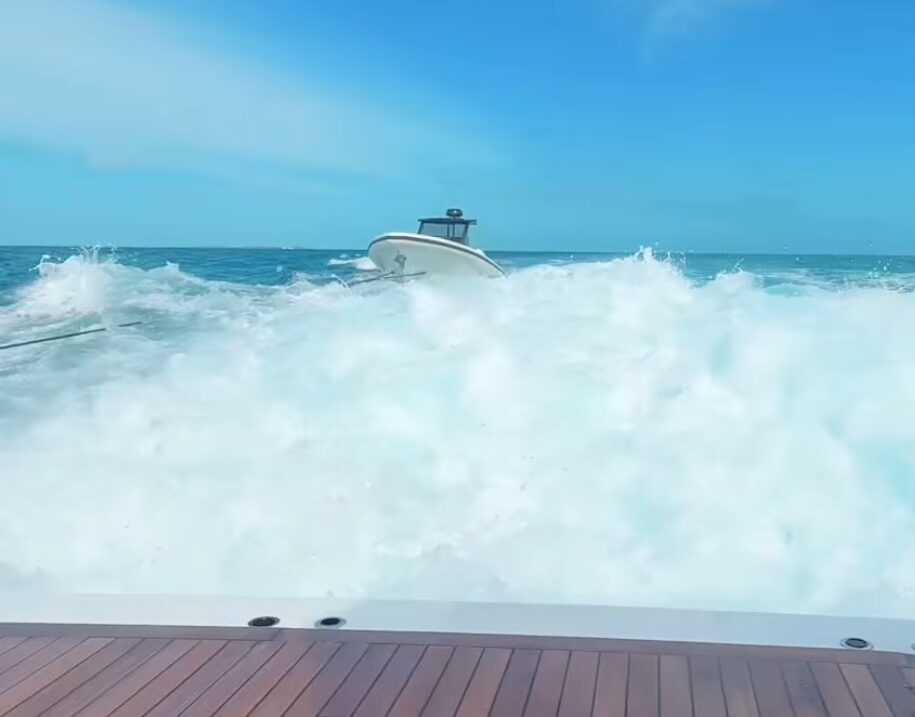
Towing is not without risks. Poor weather or following seas can put significant strain on the tow line and the tender itself. Incorrect line length or speed may lead to the tender surging, yawing, or even shipping water. Smaller yachts can also suffer from reduced fuel efficiency and handling when towing. As tenders have grown in size and value, the potential financial impact of losing one has also risen sharply.
Technology and Safety Advances
Recent years have seen significant advances in towing systems. Automatic line handling equipment now allows crew to adjust and stow tow lines from the bridge with precision. Real-time monitoring systems are also available, such as Yacht Trace, sending data on bilge levels, battery, motion, and tow-line stress directly to the mothership. If the tender breaks free, these systems can trigger alarms and even begin satellite tracking to help recover the vessel if completely lost.
Insurance Implications
Insurance companies have taken note of the growing number of towing incidents. Many have tightened restrictions, raised deductibles, or demanded proof of towing safety measures before extending cover. Monitoring systems and purpose-built towing equipment are increasingly seen as necessary steps to satisfy insurers and reduce claims. They now seek an advanced tow protection system.
Recent Milestones
- 2021 – Introduction of real-time tow monitoring technology, allowing captains to track tender health and tow line strain.
- 2022 – Insurers begin imposing stricter towing requirements, responding to high-value tender losses.
- 2024 – Manufacturers release upgraded chase boats and tenders with towing-ready hulls and improved passenger features.
- 2025 – Leading monitoring technologies are integrated into broader yacht safety systems, highlighting their importance as industry standards.
Conclusion
The trend towards towing reflects the way tenders have evolved from simple utility craft into essential, high-value extensions of the mothership. With advances in monitoring, purpose-built towing gear, and closer attention from insurers, towing is now a safer and more practical option than ever before. For many superyacht owners and captains, it has become not just a choice, but a necessity. At Yacht Trace we offer a complete monitoring system, inline with insurance to give greater flexibility, such as towing at night, away from shore, and for longer distances.